

STADS Physiotherapy
Posture problems in children
Not sitting still in the perfect posture, but moving more strongly and more freely.
or call 040 – 311 1151 / 013 – 303 0361
No referral neededSeen within 48 hoursContracts with all health insurers
You see your child slouching on the sofa more and more, with drooping shoulders or with their head pushed far forward over a screen. Perhaps they complain of back pain, neck pain or headaches after a school day. On this page you’ll read what posture problems are, when you should be concerned and how paediatric physiotherapy can help.
What are posture problems?
By posture problems we mean a posture that stands out or causes symptoms, without a clear abnormality of the spine. Think of a rounded upper back, a hollow lower back, drooping shoulders or a head that sits far forward. So it’s a posture your child adopts, not a fixed shape of the spine.
It’s good to know that there’s no single perfect posture. Everyone sits and stands differently, and the back is strong and resilient. An unusual posture doesn’t automatically lead to symptoms. However, holding one position for a long time without variety can tire the muscles and cause symptoms. Growth plays a part too: during a growth spurt, bones sometimes grow faster than the muscles can keep up, so a child may move a bit stiffly or gangly for a while.
Posture problems need to be distinguished from a fixed curvature, such as scoliosis or Scheuermann’s disease. If in doubt, the GP or orthopaedic specialist will take a look.
What symptoms can your child have?
- Pain or a tired feeling in the back, especially after sitting for a long time
- Neck pain or headaches after schoolwork or screen time
- Drooping shoulders, a rounded upper back or a hollow lower back
- Difficulty sitting still for long, or constantly fidgeting on the chair
- Tiring quickly when standing or walking
- Less strength or stamina in the trunk
Some children have no symptoms, and it’s mainly the parents who notice the posture.
What causes posture problems?
Posture comes from a mix of factors. Children and young people sit a lot these days: at school, doing homework and in front of screens. When the body gets little variety, muscles get used to that one position. Some muscles become a little shortened, others become weaker. With little exercise, general fitness also drops, so a child starts slouching sooner.
Load and load capacity also play a part. A heavy school bag, long school days or a sport with the same movement over and over ask a lot of the body. If the load capacity isn’t big enough at that moment, for example during a growth spurt or after a period of little exercise, symptoms can develop.
On top of that, some children naturally have a different build, are very flexible (hypermobile) or have less body awareness. How a child feels also plays a part. Tiredness, tension or insecurity can sometimes literally be seen in their posture. In teenagers, for example, self-consciousness about growing tall quickly can lead to a slumped posture. So there’s almost never just one cause, and that’s why we take a broad view.
How long does it last?
That varies from child to child. Symptoms caused by a one-sided posture often ease when your child starts varying positions and moving more. Some children notice a difference within a few weeks; for others it takes longer, because habits take time to change.
You don’t change a posture by sitting up straight once. It’s about strength, fitness, body awareness and habits that develop over a longer period. During growth spurts, symptoms can temporarily return. That’s usually no cause for concern, but it is a sign to pay a bit more attention to movement and variety again.
When should you see a paediatric physiotherapist?
- Your child regularly has back pain, neck pain or headaches linked to sitting or posture
- Your child finds it hard to get through a school day without symptoms
- You notice the posture and your child seems to have little strength or fitness
- Your child moves little and finds sport difficult
- You’re not sure whether it’s posture or something else, such as scoliosis
Can’t work it out on your own?
Our physiotherapists and occupational therapists are happy to help. In most cases you can come without a referral, in Eindhoven or Tilburg.
When should you see your GP?
See your GP if your child:
- Has a visible sideways curve in the back, or a hump on one side when bending forward
- Has a rounded back that can’t be straightened, even when actively standing up straight
- Has back pain that is present at night or doesn’t ease at rest
- Has a fever, is losing weight or feels ill as well as having back pain
- Has tingling, loss of strength or pain spreading into the legs
- Is younger than about four and has persistent back pain
How STADS helps with posture problems
At STADS, we start with a conversation with you and your child. With teenagers, we make a point of involving the young person themselves, because they know best when they have symptoms and what they want. We ask about school, sport, screen time and what an ordinary day looks like. Then we examine posture, the mobility of the spine, strength and fitness. That way we can also judge whether there are signs of something else, such as scoliosis.
We explain what we see and what it means. It’s often reassuring to hear that the back is strong and that there’s no damage. Together we set goals that matter to your child, such as a school day without headaches or joining in with sport again.
In treatment, we work on the strength and stamina of the trunk, shoulders and legs, on body awareness and on fitness. We don’t practise one ideal posture, but variety and movement. With young children we do this through play; with teenagers often with exercises they can do at home or at the gym. We build this up gradually and give practical tips for school and home.
Our paediatric physiotherapists consult the GP or youth doctor (jeugdarts) where needed. For older teenagers with neck or back pain, manual therapy can sometimes help as support, always combined with exercise.
What can you do yourself?
- Build in variety: after about half an hour of sitting, get up and move for a bit
- Encourage playing outside, cycling or sport every day
- Have your child carry a bag with two shoulder straps and keep the weight down
- Put the screen at eye level and agree on screen breaks
- Make sure they get enough sleep; a well-rested body slumps less quickly
- Avoid endlessly correcting with ‘sit up straight’; moving helps more than sitting still in a neat posture
Read also
Related complaints
Good to know
Frequently asked questions
Do I need a referral?
In most cases, no. You can come to our paediatric physiotherapists with your child without a referral. We then start with a short screening to see whether paediatric physiotherapy suits the symptoms. Sometimes we ask for information from your GP, youth doctor or specialist, so that we work well together.
Is it covered by insurance?
For children under 18, paediatric physiotherapy is often (partly) covered by the basic insurance. Exactly how many treatments are covered depends on the complaint, your health insurance and sometimes your supplementary package. For some chronic conditions, a different arrangement applies under the basic insurance. For more information, see reimbursements and rates or check your policy.
Is there such a thing as good and bad posture?
Not really. There’s no single perfect posture that applies to everyone. The back can handle a lot and different postures are fine. The problem mainly arises when your child stays in the same position for a long time without moving. That’s why variety, strength and fitness matter more than always sitting up neatly.
Is my child’s posture caused by their phone?
Lots of screen time can contribute, because your child then often sits in the same position for a long time with their head forward. But it’s usually a combination of factors, such as little exercise, growth and build. Banning the phone isn’t necessary. Agreements about breaks and enough exercise usually help more.
How do I know whether it’s posture or scoliosis?
With a posture problem, your child can straighten their back themselves. With scoliosis there’s a fixed sideways curve, often with a hump on one side of the back when your child bends forward. If you’re unsure, have your GP take a look or come and see a paediatric physiotherapist. We’ll refer you if needed.
Our locations
Two practices, one team
In Eindhoven and Tilburg, physiotherapists and occupational therapists work together under one roof. Choose the practice that’s easiest for you.
Eindhoven

Centrally located on Geldropseweg, with spacious treatment rooms and a large exercise room. Easy to reach by bike, public transport and car.
Address
Geldropseweg 28
5611 SJ Eindhoven
Free parking behind the building
Tilburg
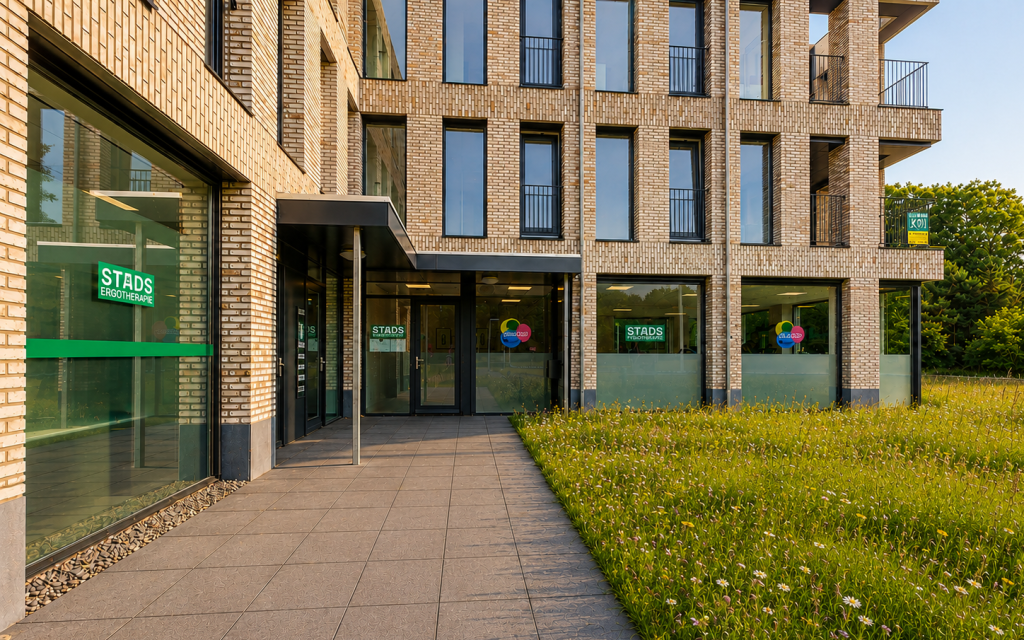
Right in the heart of the Reeshof, close to the A58 exit. Also easy to reach from the surrounding villages.
Address
Reeshofweg 40
5036 BK Tilburg
Mon to Fri, 08.00–18.00
Questions first?
Rather talk to someone first?
Not sure if we can help, or have a question about your treatment or reimbursement? Feel free to get in touch.
Call the practice
You’ll speak to one of us straight away. We’ll check the diary together there and then.
Leave your details
Fill in the contact form and we’ll get back to you as soon as possible.