
STADS Physiotherapy
Orthopaedic problems in children (0-18 years)
A growing body changes quickly; we help you see what’s normal and what needs attention.
or call 040 – 311 1151 / 013 – 303 0361
No referral neededSeen within 48 hoursContracts with all health insurers
Your child has pain in their legs, walks with their feet turned in or complains of pain during sport. Or you’re worried about bow legs, knock knees or flat feet. On this page you’ll read which orthopaedic problems are common in children and young people, what is part of normal development and when paediatric physiotherapy can help.
What are orthopaedic problems in children?
Orthopaedic problems are problems of the musculoskeletal system: bones, joints, muscles and tendons. In children and young people, these problems are different from those in adults, because the body is still growing. There are growth plates at the ends of the bones, and growth centres where tendons attach. During growth, these are more vulnerable than fully grown bone.
Much of what parents notice is part of normal development. Toddlers often have bow legs, preschoolers knock knees, and young children often have flexible flat feet. Walking with the feet turned in is also common and usually grows out by itself. Other problems do need attention, such as growth-related complaints in sporty children, recurring pain, injuries or recovery after a fracture or surgery.
Orthopaedic problems in children include, for example, growing pains, alignment differences of the legs and feet, growth-related complaints such as Osgood-Schlatter disease and Sever’s disease, sports injuries and rehabilitation after a fracture or surgery.
What symptoms can your child have?
- Pain in the legs, knees, feet or heels, often during or after activity
- Unusual alignment of the legs or feet, such as bow legs, knock knees or in-turned feet
- Often tripping, falling or tiring quickly when walking
- Pain during sport, for example when jumping or sprinting
- A recurring injury, such as a sprained ankle
- Stiffness, less strength or difficulty moving after a fracture, a cast or surgery
What causes orthopaedic problems in children?
The cause differs per problem. Many complaints in older children and teenagers have to do with the balance between load and load capacity. During growth, the body can temporarily handle less. Bones grow quickly, muscles and tendons have to adapt and growth plates are vulnerable. If a child does a lot of sport during that period, or suddenly starts doing more, the load can become greater than the body can handle. That’s when growth-related complaints or overuse injuries develop.
In younger children, it is more often about the alignment of the legs and feet. This changes a lot in the first years of life. Bow legs usually become straight legs at around two years old, after which knock knees often appear temporarily, straightening out again from about six to eight years. The arch of the foot develops gradually during the first ten years of life.
Other factors also play a part, such as heredity, build, flexibility (hypermobility), strength and fitness, and the amount and type of activity. A previous injury that hasn’t healed properly can also cause problems. Sometimes there is an underlying medical cause, which is why it’s important to recognise warning signs.
How long does it last?
That depends very much on the problem. Alignment differences that are part of normal development usually correct themselves over the years. Growing pains come and go and usually disappear after a few years. Growth-related complaints such as Osgood-Schlatter or Sever’s disease go away once growth in that area has finished, but can come and go in waves for months to sometimes a couple of years.
Recovery after a sports injury or fracture usually takes a few weeks to months. Children often recover faster than adults, but the course differs per child and per injury. That’s why we’re careful with predictions and follow progress together with you.
When should you see a paediatric physiotherapist?
- Your child regularly has pain during or after activity or sport
- You’re worried about the alignment of the legs or feet, or about the way your child walks
- Your child falls often, tires quickly or lags behind peers
- Your child has an injury that keeps coming back
- Your child needs to build up again after a fracture, a period in a cast or surgery
- You want to know how your child can keep playing sport safely while growing
Can’t work it out on your own?
Our physiotherapists and occupational therapists are happy to help. In most cases you can come without a referral, in Eindhoven or Tilburg.
When should you see your GP straight away?
Go straight to your GP or the out-of-hours GP service (huisartsenpost) if your child:
- Suddenly limps or won’t stand on one leg any more, especially if they also have a fever
- Has a swollen, red or warm joint, or feels ill
- Is in a lot of pain after a fall or accident, or can’t use the leg or arm
- Wakes up at night with pain in one specific spot, or loses weight for no clear reason
- Is a teenager with pain in the groin, thigh or knee and starts walking differently; this can come from the hip
- Has an alignment difference that is on one side only, is getting worse or comes with pain
How STADS helps with orthopaedic problems in children
At STADS, we start with a proper conversation with you and your child. With teenagers, we mainly talk to the young person themselves. What are the symptoms, since when, and what would your child like to be able to do again? We ask about sport, school, growth and previous injuries. Then we examine your child through play or, with older children, with a focus on their sport. We look at posture, alignment of the legs and feet, mobility, strength, balance and walking pattern.
We explain what we see and whether it’s part of normal development or needs attention. It’s often a relief to hear that something will go away by itself. If more is needed, we set goals together, such as joining in with PE without pain or being able to play sport fully again.
The treatment consists mainly of exercise and pacing. We work on strength, flexibility, balance and coordination, tailored to age and the problem. With growth-related complaints and sports injuries, we agree on the load and build it up gradually. After a fracture or surgery, we guide recovery in line with the hospital’s advice.
Where needed, our paediatric physiotherapists work together with the GP, orthopaedic surgeon or youth health doctor (jeugdarts). For young people who play sport intensively, sports physiotherapy can be a good addition.
What can you do yourself?
- Encourage plenty of varied activity: playing outside, cycling, climbing and swimming
- Ideally, don’t let your child do one sport intensively all year round; mix it up
- Build up training gradually, especially at the start of a season or during a growth spurt
- Make sure shoes fit well, and let young children walk barefoot regularly too
- Take pain seriously, but don’t keep your child still unnecessarily
Read also
Related complaints
Good to know
Frequently asked questions
Do I need a referral?
In most cases, no. You can come to our paediatric physiotherapists with your child without a referral. We start with a short screening to check whether paediatric physiotherapy suits the complaints. Sometimes we ask for information from the GP, youth health doctor (jeugdarts) or specialist, so that we work well together. After surgery or a fracture, it’s helpful to bring the hospital’s advice with you.
Is it covered by my insurance?
For children under 18, paediatric physiotherapy is often (partly) covered by the basic insurance. Exactly how many treatments are covered depends on the complaint, your health insurance and sometimes your supplementary package. For some chronic conditions, a different arrangement applies under the basic insurance. For more information, see our page on reimbursements and rates or check your policy.
What are growing pains?
Growing pains are pain in both legs, often in the calves, shins or behind the knees, that mainly occurs in the evening or at night. During the day your child has no trouble and walks normally. It is common in children aged about 3 to 12 and is harmless. Massage or warmth often helps. If the pain is on one side, is also there during the day or your child limps, see your GP.
Should I worry about my child’s flat feet?
Usually not. In young children, the arch of the foot is still developing and flexible flat feet are perfectly normal. If the arch becomes visible when standing on tiptoe and your child has no pain, treatment is usually not needed. If your child has pain, a stiff foot or problems on one side, have it assessed.
My child walks with their feet turned in. Is that a problem?
In-toeing is common in young children and usually disappears by itself during growth. It is often caused by a normal twist in the thigh, lower leg or foot. Special shoes or insoles are usually not needed. If your child falls a lot, has pain or it’s only on one side, have it checked.
Our locations
Two practices, one team
In Eindhoven and Tilburg, physiotherapists and occupational therapists work together under one roof. Choose the practice that’s easiest for you.
Eindhoven

Centrally located on Geldropseweg, with spacious treatment rooms and a large exercise room. Easy to reach by bike, public transport and car.
Address
Geldropseweg 28
5611 SJ Eindhoven
Free parking behind the building
Tilburg
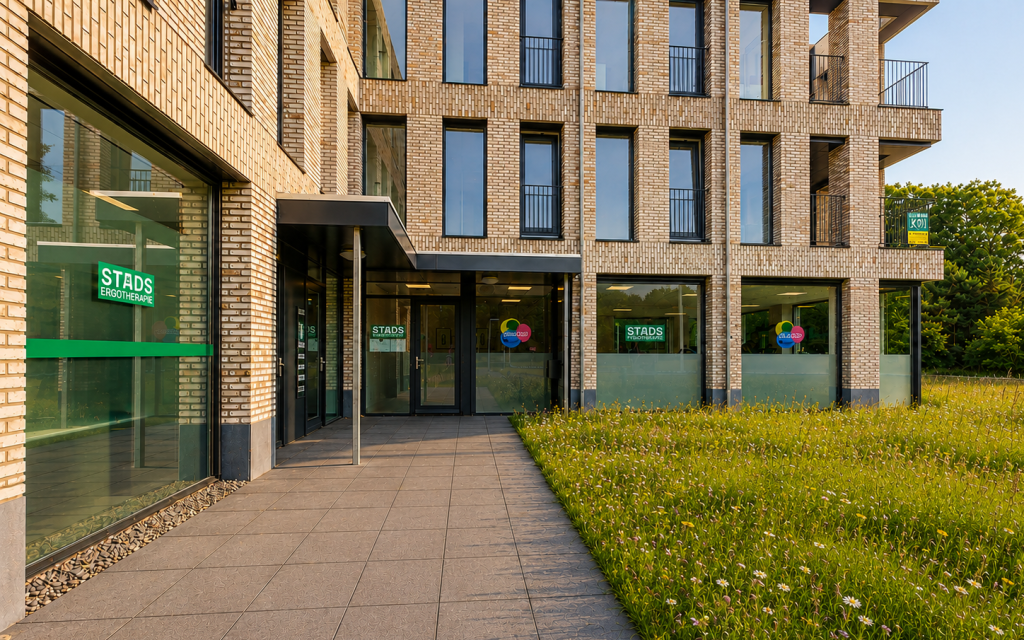
Right in the heart of the Reeshof, close to the A58 exit. Also easy to reach from the surrounding villages.
Address
Reeshofweg 40
5036 BK Tilburg
Mon to Fri, 08.00–18.00
Questions first?
Rather talk to someone first?
Not sure if we can help, or have a question about your treatment or reimbursement? Feel free to get in touch.
Call the practice
You’ll speak to one of us straight away. We’ll check the diary together there and then.
Leave your details
Fill in the contact form and we’ll get back to you as soon as possible.