
STADS Physiotherapy
Oedema therapy
 Specialists in treating fluid build-up Often results after just 1 treatment For swelling after a (sports) injury, surgery, radiotherapy or a medical condition
or call 040 – 311 1151 / 013 – 303 0361
No referral neededSeen within 48 hoursContracts with all health insurers
What is oedema?
Just like blood, lymph fluid flows through your whole body. The lymph nodes are the junctions of that system: that’s where the fluid is filtered and waste products are removed.
The balance between the supply and drainage of lymph fluid can become disturbed. There is often an underlying cause, which may be present from birth or develop later. The result is an abnormal build-up of fluid: oedema.
How do you recognise it?
- an arm, leg or other part of the body that becomes swollen, often on one side
- a heavy or tight feeling
- clothes, shoes or jewellery that feel tight even though you’re not gaining weight
- a dent that stays when you press with your thumb
- the swelling goes down a little overnight, but not completely
What does the treatment involve?
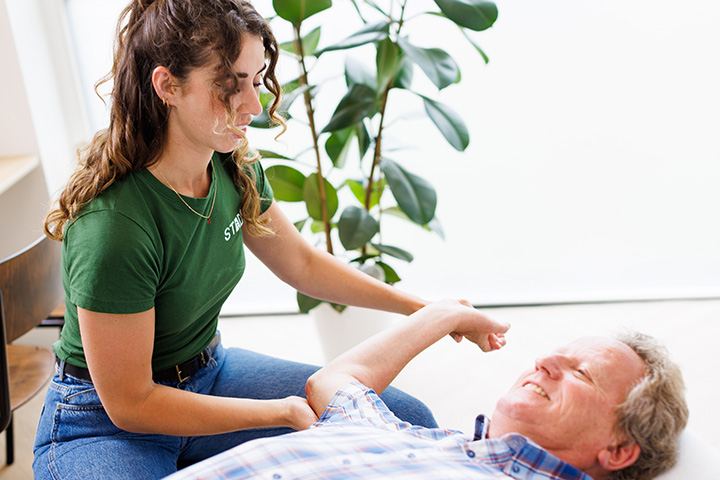
Our oedema therapists use manual lymphatic drainage, a gentle form of massage that helps get the fluid moving, combined with compression therapy, taping and exercise therapy.
We also look at the underlying cause. Treating oedema without looking at that is like mopping with the tap running; it just keeps coming back.
Why movement helps
The lymphatic system has no pump of its own. The fluid is moved by your muscles. That makes movement not an add-on to the treatment, but a core part of it.
Oedema after cancer treatment
A common cause is surgery or radiotherapy in which lymph nodes have been removed or damaged, for example with breast cancer. The swelling can appear months or even years later.
Do you notice an arm or leg getting swollen after such treatment? Don’t wait. The sooner we start, the better it can be managed.
What is oedema?
Oedema is an abnormal build-up of fluid in the body. This can be because the drainage of lymph fluid is limited, or because there is too much lymph fluid being supplied. Compression therapy stimulates the drainage of lymph fluid; a distinction is made between bandaging with high-stretch or low-stretch bandages, depending on how active the patient is.
Alongside compression therapy, manual lymphatic drainage is also used. This is a form of massage that can move fluid to areas of the body where the lymphatic system is intact. Depending on the type of oedema, this technique is applied very superficially (at skin level) or deeply (at tissue level). Special taping techniques can help promote the flow of lymph fluid at skin level.
In addition to the forms of therapy above, it’s very important to get moving through exercise therapy. When you tense your muscles, both blood and lymph fluid are pumped through the body. This happens because the veins are squeezed, pushing the fluid upwards. Because the lymph vessels, like veins, have small valves, the fluid can’t flow back down and is directed towards the heart.
Because oedema almost always stems from an underlying problem, we also pay attention to this through coaching. Together we look at how these problems can be solved, and who else may be needed to help.
What causes oedema?
Primary lymphoedema is a congenital condition: the lymph vessels are too narrow or too wide, or there are fewer vessels overall. It can occur with the following conditions:
- Hennekam syndrome
- Noonan syndrome
- Prader-Willi syndrome
- Proteus syndrome
- Turner syndrome
- Milroy disease
Secondary oedema develops later and is divided into forms caused by limited drainage of lymph fluid and forms caused by an excess of lymph fluid
Some common forms of secondary oedema with limited drainage of lymph fluid are:
- Oedema after cancer surgery (removal of lymph nodes)
- Oedema after cancer treatments such as radiotherapy and/or chemotherapy
- With malignancies
Common forms of secondary oedema with too much lymph fluid being supplied:
- Venous oedema (following thrombosis, surgery on blood vessels, pregnancy or vascular conditions such as varicose veins)
- Traumatic oedema (after an accident, surgery or infection)
- General oedema (with obesity, organ failure or hypoproteinaemia)
Other forms of oedema:
- Lipoedema (body shape is out of proportion. Strictly speaking not oedema, but symptoms can be eased somewhat with oedema therapy. Resolving this condition requires a surgical procedure)
Symptoms of oedema
The symptoms of oedema can vary depending on the severity and location of the fluid build-up. Common symptoms are:
- Swelling: The most noticeable symptom of oedema is visible swelling of the affected area, such as the ankles, legs, hands or face.
- Tight-feeling skin: The skin over the swollen area can feel tight and look shiny.
- Pain or discomfort: In some cases, the swelling can be painful or cause a heavy feeling in the affected limbs.
- Restricted movement: The swelling can make it difficult to move a joint properly, for example the ankles or knees.
- Change in skin colour: The skin over the oedema can turn red, blue or pale, depending on the cause of the oedema.
- Dents forming: When pressure is applied to the swollen area, a dent (pitting) can remain for a while, especially with oedema in the legs.
- Tiredness: With oedema in the legs, a feeling of tiredness or restlessness can occur because the body struggles to deal with the extra fluid effectively.
- Weight gain: Oedema can lead to a sudden increase in body weight, especially if a considerable amount of fluid is retained.
What does treatment for oedema involve?
Treating oedema consists of 2 phases: the decongestion phase and the maintenance phase.
Decongestion phase:
- Compression (bandaging, manual compression techniques)
- Manual lymphatic drainage
- Fascia techniques (loosening the area around radiotherapy/ scar tissue)
- With intensive treatment followed faithfully: greatly reduced/ gone within 3-5 weeks
Maintenance phase:
- Therapeutic elastic stocking (fitted by a compression stocking (TEK) specialist)
- Annual check-up with the oedema therapist
- If symptoms come back: book an appointment straight away to prevent a relapse!
Physiotherapy for oedema
With compression therapy, manual lymphatic drainage, taping where needed, exercise therapy and coaching, symptoms can be reduced or resolved in the acute phase. Then, in the maintenance phase, we look at whether further compression aids are needed. Your oedema therapist will also involve other healthcare professionals if necessary, so the underlying cause can be treated too.
Am I insured for oedema therapy?
For people under 18, oedema therapy is included in the basic health insurance package. Over 18, you need supplementary insurance to be eligible for reimbursement.
For more information, contact your health insurer, or call STADS. We’re happy to help.
What does oedema therapy cost?
Even if you’re not insured for oedema therapy, you can still come to us for it. In that case, we charge a practice rate. In some cases, your health insurer will still contribute to the treatment even if you’re not insured. This only applies at a later stage of the treatment, though. Click here for more information.
Questions first?
Rather talk to someone first?
Not sure if we can help, or have a question about your treatment or reimbursement? Feel free to get in touch.
Call the practice
You’ll speak to one of us straight away. We’ll check the diary together there and then.
Leave your details
Fill in the contact form and we’ll get back to you as soon as possible.